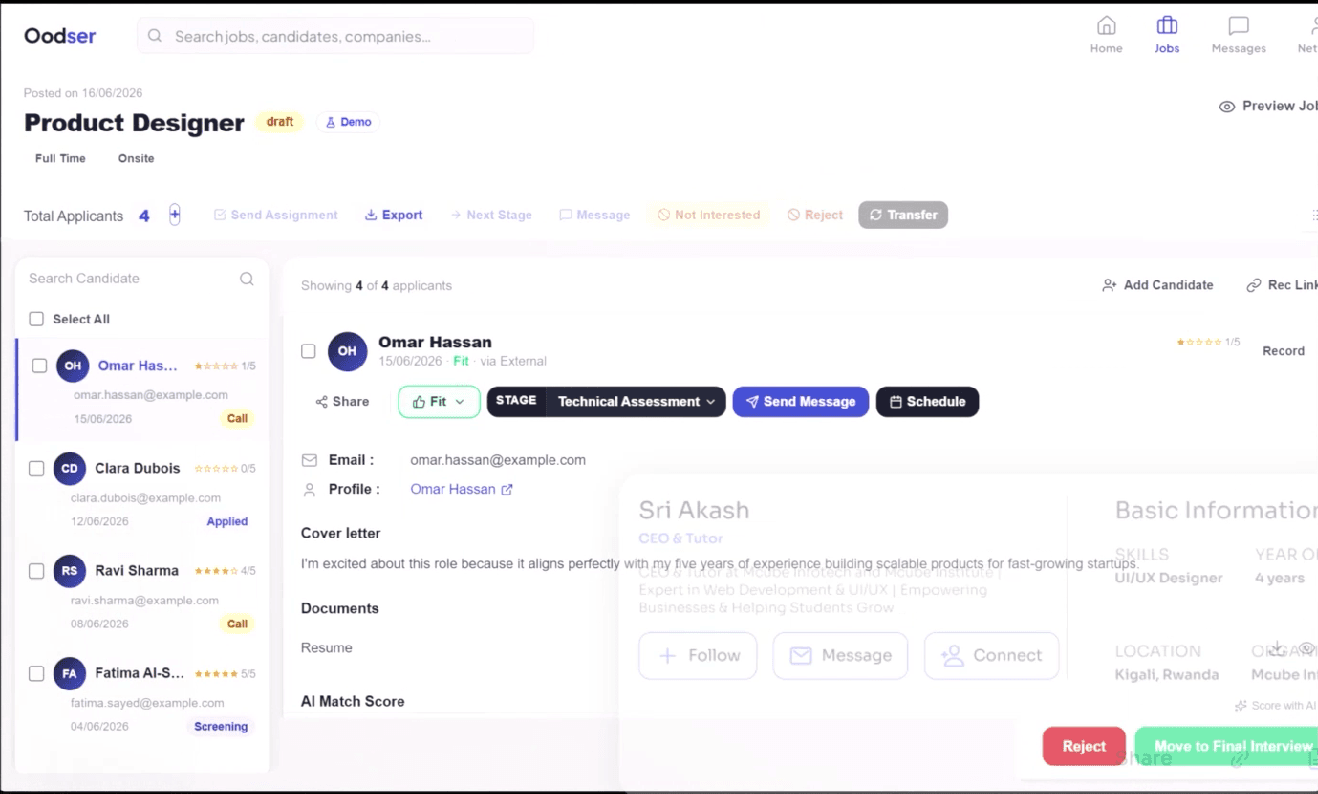
How Artificial Intelligence Is Transforming Recruitment: Benefits, Challenges, and the Future of Hiring
The article will cover how AI is changing recruitment, real-world applications, candidate screening, matching, automation, risks, ethical considerations, and what businesses should expect next.
AI can take on the repetitive parts of hiring and help teams focus on people. Used carelessly, it can also repeat old mistakes faster. Here is how to tell the difference.
Oodser Editorial Team2 min de lecture
Skills-based hiring means deciding on what people can do rather than where they studied or which titles they held. Here is what it looks like in practice.
Oodser Editorial Team2 min de lecture
Recruitment & Hiring
Most hiring problems are not about a shortage of good people. They come from avoidable mistakes in how teams define, assess and communicate.
Oodser Editorial Team2 min de lecture
Newsletter
Des lectures utiles sur le recrutement et les carrières, dans votre boîte mail
Nouveaux articles, guides pratiques et quelques nouvelles du produit. Pas de spam, et vous pouvez partir quand vous voulez.
Artificial intelligence is changing how companies discover, evaluate, and recruit talent. From intelligent candidate matching to automated applicant screening, discover how AI is making recruitment more efficient and what businesses need to understand before adopting it.
Introduction
Finding the right employee has always been one of the most important responsibilities of any organization. However, as businesses grow and competition for skilled professionals increases, traditional recruitment methods are becoming increasingly difficult to manage.
Recruiters often receive hundreds of applications for a single vacancy. Reviewing every CV, comparing qualifications, arranging interviews, and communicating with applicants can consume considerable time and resources.
At the same time, job seekers face another challenge: getting their qualifications and professional experience noticed among thousands of competing applications.
This is where Artificial Intelligence (AI) is changing the recruitment landscape.
AI-powered recruitment technologies are helping organizations automate repetitive activities, identify relevant candidates, analyze professional qualifications, and make more informed hiring decisions.
But AI in recruitment is not simply about replacing manual work with algorithms. It is about improving how organizations connect opportunities with people who have the right skills and experience.
In this article, we explore how artificial intelligence is transforming recruitment, its practical applications, its benefits and limitations, and what businesses should consider when adopting AI-powered hiring solutions.
1. What Is AI in Recruitment?
Artificial Intelligence in recruitment refers to the use of intelligent computer systems to support different stages of the hiring process.
These systems can analyze information, identify patterns, process natural language, recommend potential candidates, and assist recruiters with administrative activities.
Unlike traditional recruitment software, which primarily stores and organizes applicant information, AI-powered systems can help interpret that information and provide useful recommendations.
For example, imagine a company advertising a software engineering position.
The company receives 300 applications. Instead of requiring a recruiter to manually examine every application, an AI-assisted recruitment system can help:
Identify candidates with relevant technical skills.
Compare professional experience against job requirements.
Identify relevant certifications and qualifications.
Highlight candidates whose demonstrated experience aligns with the role.
Organize applicants according to relevant evaluation criteria.
The recruiter can then review the findings, investigate promising applications, and make informed decisions.
Importantly, AI recommendations should support professional judgment rather than independently determine who deserves employment.
2. How Is Artificial Intelligence Being Used in Recruitment?
AI can support several activities throughout the recruitment lifecycle.
2.1 Intelligent candidate sourcing
Candidate sourcing involves finding professionals who could be suitable for a particular position.
Traditionally, recruiters search through job boards, professional networks, CV databases, and referrals.
AI-assisted sourcing can make this process more efficient by analyzing available professional information and identifying potential matches.
For example, when recruiting a backend developer, a sourcing system may look for relevant experience with:
Node.js and backend development.
PostgreSQL and MongoDB.
REST APIs and system architecture.
Cloud infrastructure.
Software deployment and DevOps.
Rather than relying exclusively on job titles, intelligent sourcing can help recruiters discover professionals whose actual experience matches the position.
2.2 Automated CV and application screening
One of the most time-consuming recruitment activities is reviewing applications.
AI-assisted screening can extract information from CVs and application documents, helping recruiters organize large numbers of submissions.
Depending on the system, this may include identifying:
Educational qualifications.
Professional experience.
Technical and soft skills.
Relevant projects.
Certifications.
Previous responsibilities.
However, screening systems must be configured carefully.
A candidate should not automatically become unsuitable simply because their CV uses different terminology from the job advertisement.
For example, a candidate who describes themselves as a software developer may have the same relevant experience as someone whose CV says application engineer.
Good screening should consider context rather than simply count matching keywords.
2.3 AI-powered candidate matching
Candidate matching is one of the most promising applications of AI in recruitment.
Traditional recruitment searches frequently depend on keywords, job titles, and predefined filters.
AI-assisted matching can go further by comparing the meaning and relevance of information contained in job descriptions and professional profiles.
Consider a company looking for a project manager with experience coordinating software development teams.
A suitable candidate might have a background in:
Agile project management.
Software development coordination.
Stakeholder communication.
Project delivery.
Team leadership.
Even if the candidate's previous job title was Technical Lead rather than Project Manager, their experience could still be relevant.
Intelligent matching can help identify these connections.
The goal is not to find candidates who simply resemble the job description. It is to identify professionals whose capabilities and experience are relevant to the actual responsibilities of the position.
2.4 Automated candidate communication
Recruitment involves continuous communication between employers and applicants.
Candidates want application updates, interview invitations, reminders, and feedback.
Recruiters, meanwhile, need to coordinate these communications across multiple vacancies.
AI-powered communication assistants can help organizations:
Answer frequently asked recruitment questions.
Provide application status information.
Schedule interviews.
Send reminders.
Explain application requirements.
Guide candidates through recruitment stages.
Automation can reduce administrative work while helping candidates receive more timely communication.
Organizations should still make it clear when applicants are interacting with automated assistants.
2.5 Recruitment analytics and reporting
Recruitment data can provide valuable information about how effectively an organization attracts and hires talent.
AI-assisted analytics can help HR teams understand:
Which recruitment channels attract qualified applicants.
How long different recruitment stages take.
Where candidates commonly abandon applications.
Which positions attract the highest application volumes.
How recruitment performance changes over time.
These insights help organizations identify bottlenecks and improve their hiring processes.
3. The Major Benefits of AI in Recruitment
Adopting AI does not automatically guarantee better hiring outcomes. However, when implemented responsibly, it can provide several important benefits.
Faster recruitment processes
Automating repetitive activities can reduce the time recruiters spend organizing applications, extracting information, and coordinating communication.
This allows HR teams to concentrate more on interviews, candidate evaluation, and hiring decisions.
Better candidate discovery
AI-assisted matching can help identify relevant professionals who might otherwise be overlooked by conventional keyword-based searches.
This is particularly valuable when recruiting for specialized technical positions.
Improved recruitment consistency
Well-designed systems can apply consistent, job-related evaluation criteria across applications.
This can help recruiters organize their assessments and reduce unnecessary variation between different hiring processes.
Consistency does not automatically mean fairness, however. The criteria themselves must be appropriate and regularly reviewed.
Better candidate experience
Candidates benefit when organizations provide clearer information, faster communication, and more organized application processes.
Automated assistance can help answer routine questions without requiring applicants to wait for a recruiter to become available.
Data-driven recruitment decisions
Recruitment analytics can help businesses understand what is working and what needs improvement.
Instead of relying entirely on assumptions, HR teams can use measurable indicators to evaluate their recruitment strategies.
4. The Challenges and Risks of AI-Powered Recruitment
Although AI offers significant opportunities, organizations should understand its limitations before introducing it into hiring processes.
4.1 Algorithmic bias
AI systems learn patterns from data.
If historical recruitment data contains discriminatory patterns or unfair preferences, an AI system may reproduce or reinforce those patterns.
For example, if a company historically recruited candidates from a narrow group of universities, an improperly designed system might favor applicants from those institutions even when other candidates possess equivalent qualifications.
The solution requires more than simply using a different AI model.
Organizations should regularly evaluate their systems, review their data, test outcomes across relevant groups, and ensure that hiring criteria are genuinely related to job requirements.
4.2 Data privacy and security
Recruitment systems process personal information, including:
Names and contact information.
Employment histories.
Educational backgrounds.
CVs and supporting documents.
Interview information.
Professional references.
Organizations must understand what information their recruitment systems collect, how it is processed, who can access it, and how long it is retained.
Businesses should also examine the data protection practices of external AI providers before sharing candidate information.
4.3 Overdependence on automation
AI can make recommendations, but it does not fully understand every aspect of human potential.
A candidate might have limited formal employment experience but demonstrate exceptional problem-solving skills through personal projects.
Another candidate might have an unconventional career path that provides valuable experience for a particular role.
Overreliance on automated rankings can cause organizations to overlook such individuals.
Human oversight remains essential.
4.4 Lack of transparency
Candidates should be able to understand when automated systems are being used in important parts of the recruitment process.
Organizations should be prepared to explain the criteria behind assessments and provide appropriate ways to raise concerns or request human review.
The International Labour Organization has also highlighted concerns around unclear objectives, biased data, and opaque AI systems in human resource management.
International Labour Organization+1
5. AI Recruitment vs Traditional Recruitment: What Is the Difference?
AI does not make every traditional recruitment activity obsolete. Instead, it changes how certain activities are performed.
Recruitment activity
Traditional approach
AI-assisted approach
Candidate sourcing
Manual searches
Intelligent discovery
CV screening
Manual document review
Automated information extraction
Candidate matching
Keywords and filters
Contextual matching recommendations
Communication
Manual emails and calls
Automated assistance
Interview scheduling
Manual coordination
Scheduling assistance
Reporting
Manual spreadsheets
Automated analytics
Hiring decisions
Recruiter judgment
Human judgment supported by AI insights
The most effective approach combines technology with human expertise.
Recruiters understand organizational culture, interpersonal communication, team dynamics, and the context behind hiring requirements.
AI can help process information and surface patterns, but these human capabilities remain important.
6. How Businesses Can Successfully Adopt AI in Recruitment
Organizations do not need to transform their entire HR department overnight.
A practical adoption strategy should begin with understanding existing recruitment challenges.
Step 1: Identify recruitment bottlenecks
Determine which activities consume the most time or create the greatest difficulties.
For some businesses, it may be CV screening. For others, it may be candidate sourcing, communication, or recruitment reporting.
Step 2: Select appropriate AI tools
Choose technology based on actual business requirements rather than adopting AI simply because it is becoming popular.
Evaluate functionality, integration capabilities, security, transparency, and scalability.
Step 3: Establish clear evaluation criteria
Define the qualifications, skills, experience, and responsibilities required for each position.
AI systems should be evaluated against relevant job requirements rather than vague assumptions about an ideal candidate.
Step 4: Maintain human oversight
Ensure that qualified recruiters can review recommendations, investigate unusual outcomes, and make final hiring decisions.
Step 5: Monitor performance and fairness
Measure recruitment outcomes regularly.
Evaluate whether the technology is improving efficiency without creating unfair disadvantages for particular groups of candidates.
Step 6: Improve continuously
Recruitment requirements change as organizations grow.
Regularly review AI configurations, job requirements, candidate feedback, and system performance.
The UK Government's Responsible AI in Recruitment guidance provides a useful framework for organizations evaluating these technologies, including transparency, fairness, assurance, and accountability.
7. What Does the Future of AI in Recruitment Look Like?
AI recruitment technology is continuing to evolve.
Several developments are likely to influence how organizations attract and evaluate talent.
Skills-based candidate evaluation
Organizations are increasingly interested in what candidates can actually do rather than relying exclusively on academic qualifications or job titles.
Future recruitment systems may make it easier to connect demonstrated capabilities, professional projects, certifications, and experience with specific job requirements.
More intelligent professional matching
As AI systems become better at understanding context, candidate matching may move beyond basic keyword comparisons.
This could help organizations discover professionals with transferable skills and unconventional career backgrounds.
Personalized recruitment experiences
AI assistants may provide more personalized guidance throughout the application process, helping candidates understand vacancies, application requirements, and recruitment stages.
Greater focus on responsible AI
As AI becomes more involved in employment decisions, organizations will face increasing expectations around transparency, fairness, privacy, and accountability.
Technology providers and employers will need to demonstrate that their systems work as intended and do not introduce unnecessary risks.
Human-AI collaboration
The future of recruitment is unlikely to be about completely removing recruiters.
Instead, AI will increasingly support professionals by handling information-intensive activities while humans concentrate on judgment, relationships, and final decisions.
The ILO's 2025 research on generative AI and jobs found that approximately one in four workers globally are in occupations with some degree of exposure to generative AI. It also emphasizes that job transformation is more likely than complete job replacement for most affected occupations.
International Labour Organization
8. Why Modern Businesses Need Smarter Recruitment Technology
As businesses compete for talent, recruitment efficiency becomes an important operational advantage.
Companies need systems that help them organize applications, understand candidate qualifications, identify relevant professionals, and manage recruitment activities efficiently.
A modern recruitment platform should do more than collect CVs.
It should help organizations establish a structured process for discovering, evaluating, and connecting with qualified professionals.
This is where platforms such as Oodser aim to contribute to the evolution of recruitment.
By bringing recruitment activities into a more structured digital environment and emphasizing professional credibility and intelligent matching, Oodser supports a more informed approach to connecting employers with talent.
The objective should always remain the same: helping organizations identify the right people while giving professionals meaningful opportunities to demonstrate their capabilities.
Conclusion: AI Is Changing Recruitment, but People Still Matter
Artificial intelligence is creating new possibilities for recruitment.
From automated application processing to intelligent candidate matching, businesses can use AI to simplify administrative activities, improve candidate discovery, and gain better insights into their hiring processes.
However, successful AI adoption requires more than purchasing software.
Organizations must consider data quality, privacy, transparency, fairness, and human oversight.
The businesses that benefit most will not necessarily be those that automate everything. They will be those that understand where AI adds value and use it responsibly to improve human decision-making.
Recruitment has always been about connecting people with opportunities. AI is providing new ways to make those connections more efficiently.
The future of recruitment is not simply artificial intelligence. It is better collaboration between intelligent technology and human judgment.